 LunarSolar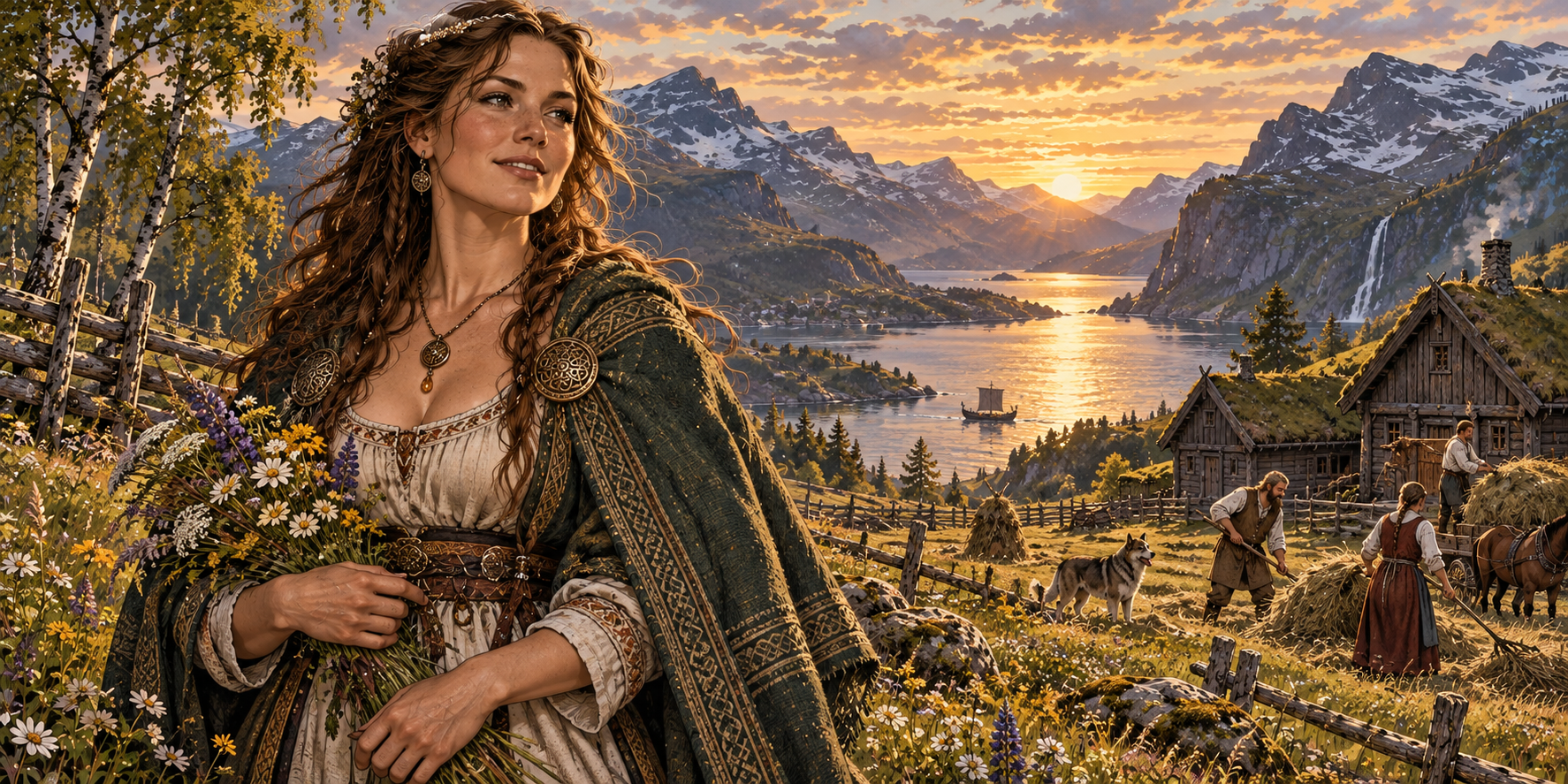
The stories of sky and feast
Summer Solstice
Summer Solstice. The long northern day reaches its height.
Light spread across the land
At the summer solstice the northern hemisphere reaches its longest daylight. The Sun's annual northward movement has arrived at its turning point. Depending on where you stand, the night may be short, filled with twilight, or absent above the Arctic Circle. The land has long hours in which to grow, and people have light for work, journeys and gathering.
This abundance belongs inside the Old Norse summer half-year. It is a working season as well as a beautiful one: the household's future food, fodder and wealth are taking shape. The Sun's turning begins the gradual journey towards shorter days while summer life continues around it.
Sól and the observed sky
The mythic Sól carries the Sun through a world of pursuing wolves and cosmic danger. Her persona gives the familiar course of light a living place in the stories. Observation had its own role alongside narrative. Star-Oddi's medieval astronomical text examines the solstices and the directions of the Sun, connecting northern experience with the effort to reckon time.
Summer's two bright landmarks
LunarSolar marks the solstice as a solar event and places Midsummar on Sólmánuður's full moon. One follows the year's changing daylight; the other follows the Moon's fullness. The two rhythms meet in the bright heart of the calendar without needing to fall on the same date.
A long evening can hold both meanings: the Sun keeping the land awake and the Moon continuing a cycle that will outlast the summer light.
Sources
National Weather Service, solstices and seasons; Thorsteinn Vilhjálmsson, Star-Oddi's astronomy; Gylfaginning, chapters 11–12.